

All of Jesus's teachings, commandments,
beatitudes and parables can be summarized
by two of His words:
Be perfect.
Matthew 5:48
THE PRECEPT
These are not merely words of encouragement. They express a precept—direct, unqualified, and addressed to every soul. The Catechism affirms this universal call:
"All Christians in any state or walk of life are called to the fullness of Christian life and to the perfection of charity"
CCC 2013
Christ does not say: be good enough. He does not say: avoid the worst. He says: be perfect, as your heavenly Father is perfect.
The problem
We have set the standard tragically low.
For many Catholics, the highest practical goal of the spiritual life is simply to die in a state of grace, free from unrepented mortal sin. This is an immeasurable good—it means dying in friendship with God and being saved from hell. But when this becomes the extent of a person's spiritual ambition, the standard has been set tragically low. Avoiding eternal separation from God is not the same as pursuing perfect union with Him.
The soul aiming only to avoid mortal sin asks:
"How little can I give God without losing Him?"
The soul aiming at perfection asks:
"What remains within me that I have not yet surrendered to Him?"
The call
Not the threshold. The summit.
Christ does not call us merely to remain above the threshold of damnation. He commands us to be perfect—to love God with our whole heart, soul, mind, and strength, and to surrender everything that prevents complete union with Him.
The Christian life is not a calculated effort to avoid hell. It is the total and unreserved pursuit of God, accomplished through complete surrender to His grace.
The foundation
We cannot do this alone.
The moment we recognize that we are called to perfection, we must also recognize that we are powerless to attain it by ourselves. This realization should not lead to discouragement, but to complete trust in God's mercy and unlimited power. We do not make ourselves perfect. We surrender ourselves to God so that His grace may transform us and the perfection of Christ may become increasingly present within us. The holiness is His. The glory is His.
We may not attain perfect charity in this life, but nothing less can be our aim. If we knowingly settle for spiritual mediocrity, we cannot claim to be pursuing perfect love.
THE UNIVERSAL CALL
Everybody Is Called to Be Perfect
With No Exception
Christian perfection is not reserved for priests, religious, mystics, or a small number of extraordinary souls. Every Christian, in every state and walk of life, is called to the fullness of the Christian life and the perfection of charity.¹ God does not create some souls for holiness and others for spiritual mediocrity. The call is universal because the command and invitation of Christ are universal.
Through sanctifying grace, the Holy Trinity dwells within the soul. Every person living in the state of grace possesses the supernatural foundation necessary for deeper union with God. This does not mean that every soul will have identical experiences or receive extraordinary mystical phenomena. It means that no soul is excluded from the possibility of profound holiness and intimate union with God.
If a soul does not yet experience God's presence deeply, it is not because God is unwilling to draw that person closer to Himself. Antonio Royo Marín explains that the obstacle is the soul's incomplete detachment from the things of earth.² Sin, self-will, pride, fear, disordered attachments, and resistance prevent us from surrendering ourselves fully and unreservedly to God. He desires to work within us, but He does not force us to cooperate with His grace.
The important distinction is not between those who are called and those who are not. Everyone is called. The distinction is between those who continue along the way and those who stop. Saint John of the Cross likewise teaches that the soul must become detached from everything that prevents the transforming work of divine love.
"But since he said 'all,' without any condition, I am sure that none will lack this living water unless they stop on the way."³
— St. Teresa of Ávila
No one should conclude that he is too weak, too sinful, too ordinary, or too far behind to pursue perfection. Our weakness is not an obstacle when it leads us to trust completely in God's mercy and power. We cannot perfect ourselves, but we can desire perfection, surrender what obstructs grace, and allow God to accomplish His work within us.
The invitation is for everyone. The grace comes from God. Our responsibility is to desire Him, trust Him, surrender to Him, and never stop along the way.
¹ Catechism of the Catholic Church, 2013.
² Antonio Royo Marín, O.P., The Theology of Christian Perfection, trans. Jordan Aumann, O.P., p. 53.
³ St. Teresa of Ávila, The Way of Perfection, ch. 19, quoted in Royo Marín, The Theology of Christian Perfection, p. 53; cf. St. John of the Cross, The Living Flame of Love, stanza 2.
The pipeline of grace
The Pipeline of Grace
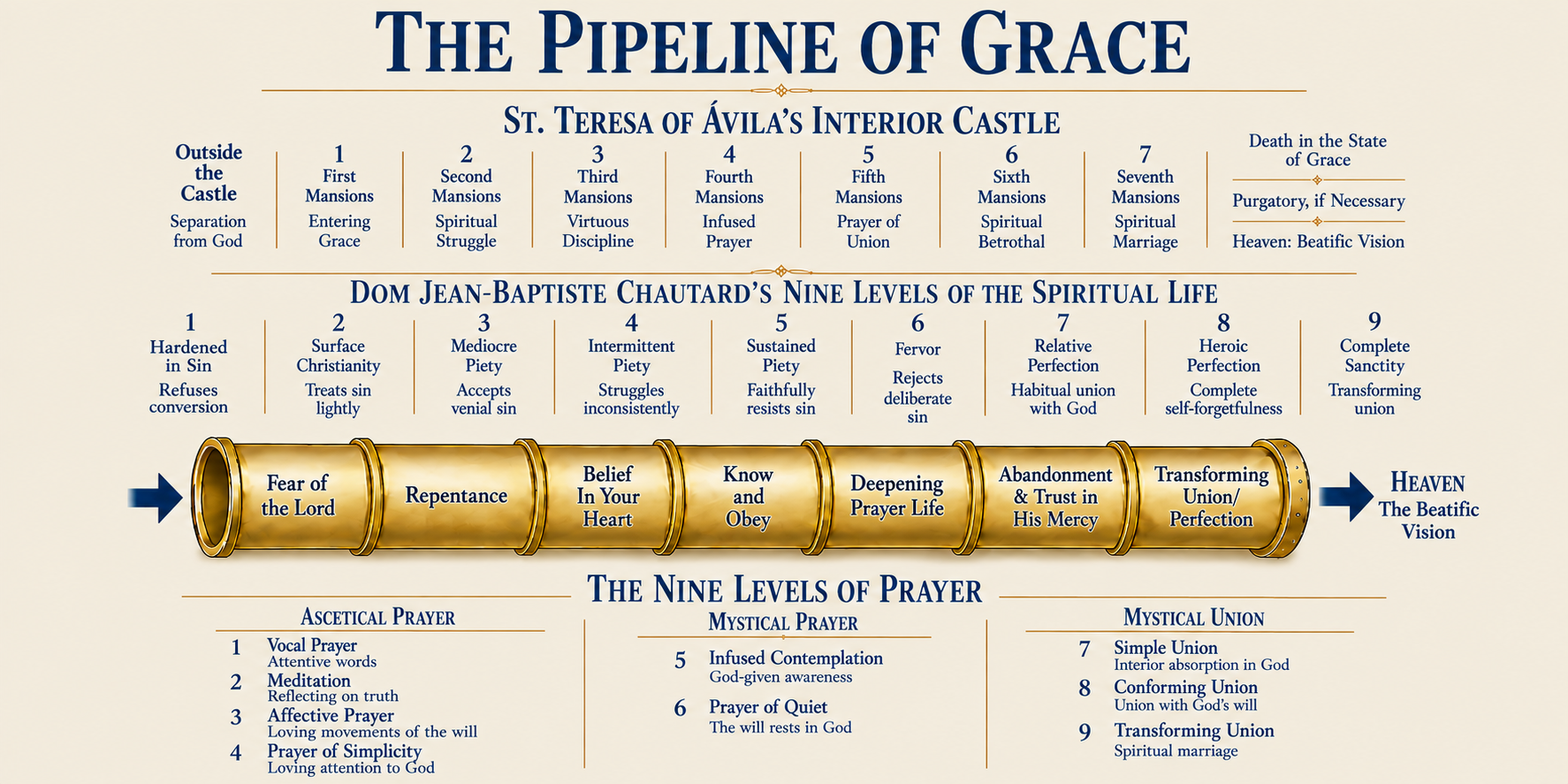
The Pipeline of Grace illustrates the soul's journey from separation from God to transforming union with Him. It brings together the teachings of several great spiritual masters into one path toward holiness and the perfection of charity.
A map of the interior life
A Map of the Interior Life
Grace leads the soul through a process of conversion, purification, prayer, surrender, and union with God. The journey begins when we recognize our separation from Him and develop a holy fear of losing His love. That recognition leads to repentance, genuine belief, and a commitment to know and obey God's will.
As the spiritual life deepens, prayer becomes more than an occasional practice. It becomes a growing relationship with God, through which the soul learns to abandon itself to His mercy. The destination is transforming union: a life increasingly conformed to God and perfected through His grace.
I
Fear of the Lord
The beginning of wisdom. Receive reality as gift. Let reverence become the foundation of everything that follows.
II
Repentance
Turn again toward God with an honest heart. Acknowledge what has separated you from Him and desire to be made new.
III
Belief in Your Heart
Entrust your whole life to Jesus Christ—not merely the parts you can control, but everything.
IV
Know and Obey
Learn His voice. Let love take concrete shape in daily faithfulness to His commandments and His will.
V
Deepening Prayer Life
Remain with God long enough for the heart to become quiet, receptive, and true. Move from words to silence, from petition to presence.
VI
Abandonment and Trust in His Mercy
Abandon every self-protective claim. Surrender your plans, your fears, and your future to the mercy and power of God.
VII
Transforming Union/Perfection
Love God with an undivided heart. As His grace makes perfect charity present within you, the perfection of Christ becomes increasingly your own.
Drawn from the Church's Spiritual Tradition
These are not new ideas. The Pipeline brings together complementary teachings from Sacred Scripture and the Church's great spiritual teachers.
Sacred Scripture
"Be perfect, therefore, as your heavenly Father is perfect." — Matthew 5:48
Saint Teresa of Avila
The Interior Castle traces the soul's passage through seven mansions toward full communion with God.
Dom Jean-Baptiste Chautard
The Soul of the Apostolate insists that the interior life must come first—that all fruitful action flows from union with God.
Saint Bonaventure
The soul's journey is an ascent: from creation, through Christ, into God—a movement of love made possible by grace.
The Nine Levels of Prayer
From vocal prayer through infused contemplation, the tradition maps the soul's deepening receptivity to God's transforming work.
Saint John of the Cross
The Dark Night of the Soul describes the soul's passage through purification—the stripping away of attachments and consolations—so that it may be united with God in pure love.
The Catechism of the Catholic Church
The Church's authoritative summary of the faith affirms the universal call to holiness and the means by which every soul is invited to grow in union with God.
Discover how the stages correspond with the Interior Castle, the levels of the spiritual life, and the levels of prayer.
THE LEAKS
Grace is given freely.
But it can be resisted.
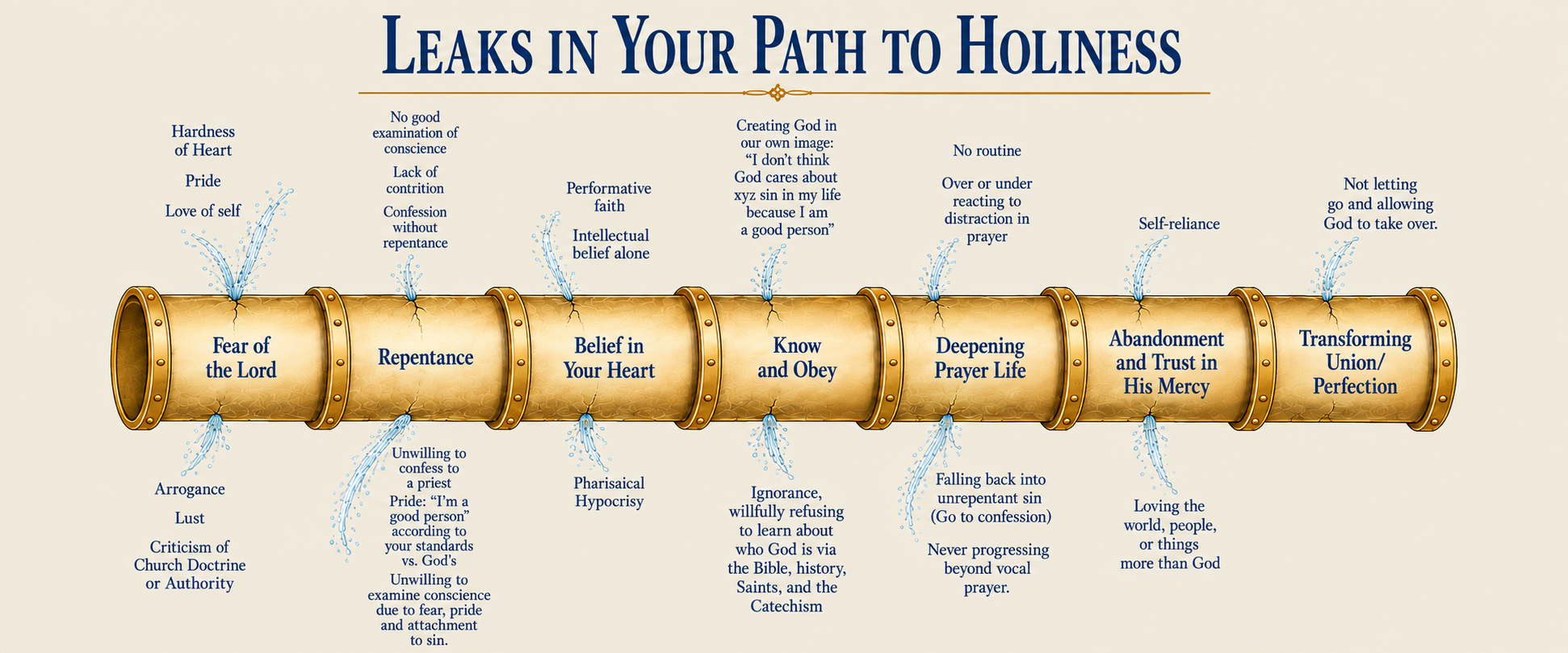
Sin, attachment, fear, and compromise obstruct the soul's response to grace.
Leaks in the Pipeline
The Pipeline shows the soul’s path toward union with God. Along that path, however, we can resist grace in countless ways. Sin, attachment, fear, self-deception, and compromise are just some of the leaks that hinder our progress and keep us from responding fully to God.
The Chaplet of Perfection
How to pray the Chaplet of Perfection.
The suggested time to pray the Chaplet of Perfection is 7:00 a.m., 7:00 p.m., or both, reflecting the biblical significance of seven as a symbol of perfection and completeness.
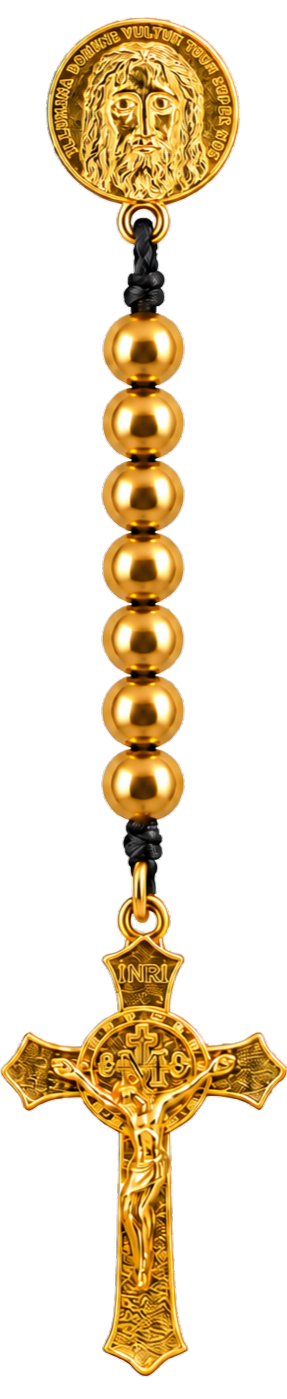
On the crucifix
"Holy Trinity, give me the grace to be perfect, because on my own, I am helpless. Provide me the endurance to persevere."
Our Father, who art in heaven…
"Holy Trinity, let me fear nothing but offending you, because you are perfect and worthy of my perfect love."
Hail Mary, full of grace…
"Holy Trinity, grant me true repentance, perfect contrition, and the willingness to always come back to you when I fall."
Hail Mary…
"Jesus, make my heart like yours. I believe in you with all my heart, mind and soul. Perfect my belief."
Hail Mary…
"Holy Spirit, reveal yourself to me through your gifts and through study, that with a deeper knowledge, I may be made perfect in my obedience to your doctrines, decrees, and precepts."
Hail Mary…
"Jesus, teach me to pray. Give me the grace to meditate on your mysteries. Purge me of my selfish way, and illuminate my soul so that I may be perfectly holy."
Hail Mary…
"Jesus, I give myself entirely to you, do with me as you please. Your plan is perfect. I trust in you and your endless mercy. Make me perfect, because on my own, I am wretched."
Hail Mary…
"Jesus, make my heart your heart. Pour your precious blood over me, that I may be joined to you in perfect love."
Hail Mary…
On the Holy Face of Jesus
"St. Faustina, St. Teresa of Ávila, St. Thérèse of Lisieux, St. Alphonsus Liguori, St. Francis de Sales, St. John of the Cross, pray for us."
Glory Be to the Father…
The Practices
A way of life ordered toward God.
The pursuit of perfection must take concrete shape in how we speak, think, pray, sacrifice, and receive God's grace.
Silence
- Overall, speak less.
- Guard your tongue against gossip, boasting, deceit, and vainglory.
- Make time for silence.
- Unplug and learn to hear your inner thoughts, including how self-centered, prideful, defensive, and judgmental they can be.
- Allow only information that makes you better to enter your mind. Waste no time entertaining sinful thoughts, whether they come from yourself, others, or the media.
Stop Judging Others
Except when judgment falls within your legitimate jurisdiction and is necessary for the good of others and the sake of fairness.
- Your sins and imperfections are enough to spend the time correcting. Work on yourself and cooperate with God's grace.
- Regard others as more important than you. Humility is the antidote to judgment.
- Learn to beg God to make you love Him perfectly. Do not pray for this casually. Plead with Him earnestly and persistently, recognizing that only His grace can accomplish it in you.
Trade.
"When faced with temptation, 'God of mercy and abundance, I trade the desired good of this temptation for your infinite gifts and joy in heaven.'"
Pray
- Learn how to pray. Do not assume you already know how. Most people don't, and you may be one of them.
- Study the nine levels of prayer, which unfold across the three ways: purgative, illuminative, and unitive.
- Spend at least 30 minutes in mental prayer each day.
- Meditate often on Christ's Passion.
- Tell Jesus often that you love Him.
- Remain close to Our Lady and ask for her intercession.
- Pray the Rosary daily.
Sacramental and Devotional Life
Mass
Work toward attending Mass daily. If you sincerely desire it, God will make possible what is possible. That's all you need.
Adoration
Make a Holy Hour or short visit whenever you can.
Confession
Go to Confession at least monthly, although weekly is best.
THE PROPER ORDER
The Interior Life and the Active Life
The interior life is the life of the soul with God. It grows through prayer, grace, recollection, and an increasing desire to know and follow His will. The active life consists of our visible work and responsibilities: serving our families, fulfilling our vocations, helping others, and completing the duties entrusted to us.
The Interior Life Must Lead
Both are necessary, but they must remain properly ordered. The interior life must guide the active life. Otherwise, we can become so occupied with what we are doing that we lose sight of why we are doing it and whether God is actually asking it of us.
The key to perfection is to give greater attention to the interior life than to the active life. When our interior life is in order, we become more capable of hearing God's voice and recognizing the movements of His grace. We begin to understand more clearly where, when, and how He wants us to act.
Activity Can Become Disordered
Without this interior foundation, even good activity can become disordered. We may act from pride, anxiety, impatience, ambition, or the desire for approval. We may remain constantly busy while neglecting the transformation God desires to accomplish within us. It is possible to perform many good works while still resisting Him in the depths of the soul.
A strong interior life purifies our motives and brings our actions into conformity with God's will. It helps us distinguish between what is genuinely ours to do and what merely distracts us from our vocation. It teaches us when to act, when to wait, when to speak, and when to remain silent.
Action Becomes Fruitful
As our union with God deepens, our active life becomes more purposeful and fruitful. We no longer rely solely on our own plans, abilities, or effort. Instead, we allow God to direct our work and act through us. Even ordinary duties can then become acts of love offered in cooperation with His grace.
The answer is not to withdraw from our responsibilities or to treat action as unimportant. It is to make certain that our activity flows from a soul attentive to God. The more faithfully we cultivate the interior life, the more clearly we will understand how to spend our active life—and the more fruitful that life will become.
The interior life does not replace the active life. It directs, purifies, and gives supernatural fruitfulness to it.
THE THREE WAYS
The Path of Spiritual Growth
Although the Church's spiritual masters identify recognizable stages of growth, every person is led by God in a distinct way.
"Each soul follows its own path to sanctity under the direction and impulse of the Holy Ghost; there are no two persons absolutely identical, either in body or in soul."
—Antonio Royo Marín, O.P., The Theology of Christian Perfection, p. 218
No classification can perfectly describe the work of grace within every person. The spiritual life is too varied and mysterious to be reduced completely to human categories. Nevertheless, the traditional division of the Christian life into the purgative, illuminative, and unitive ways provides a useful guide for understanding the soul's progress.
The Purgative Way
The purgative way begins when a person sincerely turns toward God and begins fighting against sin.
"When the soul begins to desire sincerely to live in a Christian manner, it enters the purgative way or the first degree of charity."
—Royo Marín, p. 219
At this stage, the soul's principal work is purification. It learns to resist the passions, abandon mortal sin, combat deliberate venial sin, receive the sacraments more faithfully, and develop a consistent life of prayer. Growth may initially be weak or inconsistent, but the soul gradually becomes more serious about avoiding sin and removing what impedes charity.
Quoting St. Thomas Aquinas, Royo Marín explains:
"At first it is man's principal concern to avoid sin and resist the passions, which move him in opposition to charity."
—St. Thomas Aquinas, quoted in Royo Marín, p. 219
The Illuminative Way
The soul enters the illuminative way after choosing a more stable life of prayer, virtue, and devotion.
"When the soul has decided to enter upon a life of solid piety and to advance along the way of virtue, it has entered upon the illuminative way."
—Royo Marín, p. 220
This transition is sometimes called a second conversion. The soul is no longer concerned only with avoiding serious sin. Its attention turns increasingly toward strengthening charity, correcting imperfections, growing in virtue, and seeking a more complete conformity to God.
As this way develops:
"Their practices of piety become more simple and less numerous but are practiced with greater love."
—Royo Marín, p. 221
Prayer becomes more habitual, recollected, and contemplative. The soul develops a stronger desire for God, a greater love of solitude and the Cross, and a more sincere detachment from self.
The Unitive Way
The unitive way begins when union with God becomes the governing purpose of the soul.
"When the life of prayer becomes, as it were, the very breathing of the soul, even amidst its occupations and duties of state … the soul has entered the unitive way."
—Royo Marín, p. 221
At this stage, imperfections are quickly rejected, prayer becomes deeply habitual, and the soul's practices are performed with extraordinary fidelity. Yet the soul is less concerned with the practices themselves than with being united more intimately with God.
"Their disinterest in self has reached the point of forgetfulness of self."
—Royo Marín, pp. 221–222
In the highest development of this way, love becomes the soul's principal occupation. Royo Marín quotes St. John of the Cross:
"Now loving is my only exercise."
—St. John of the Cross, quoted in Royo Marín, p. 222
Such souls possess profound humility, peace, simplicity of intention, and an intense yet tranquil love. Their concern is no longer themselves, but the honor and glory of God.
One Destination, Distinct Paths
These stages should not be treated as a rigid formula. Souls may progress differently, possess characteristics associated with more than one stage, or experience purification and illumination simultaneously.
"It admits of an infinite variety of modification because no two souls are exactly alike."
—Royo Marín, p. 222
The stages provide a guide, not a mechanical system. God personally directs each soul toward the same end: complete purification, perfect charity, and transforming union with Him.
Source: Antonio Royo Marín, O.P., The Theology of Christian Perfection, translated by Jordan Aumann, O.P., pp. 218–222.
Self-Examination and Spiritual Direction
The Nine Levels of the Spiritual Life
A Guide for Self-Examination and Spiritual Direction
In The Soul of the Apostolate, Dom Jean-Baptiste Chautard provides spiritual directors with guidance for assessing the spiritual progress of those entrusted to their care. His framework can be considered alongside the Pipeline of Grace as a helpful measure of one's own spiritual progress.

The Pipeline of Grace
Complete Sanctity
Imperfections. Hardly apparent.
Prayer. Usually, transforming union. Spiritual marriage. Purifications by love. Ardent thirst for sufferings and humiliations.
Heroic Perfection
Imperfections. Nothing but the first impulse.
Prayer. Supernatural graces of contemplation, sometimes accompanied by extraordinary phenomena. Pronounced passive purifications. Contempt of self to the point of complete self-forgetfulness. Prefers suffering to joys.
Relative Perfection
Imperfections. Guards against them energetically and with much love. They only happen with half-advertence.
Prayer. Habitual life of prayer, even when occupied in external works. Thirst for self-renunciation, annihilation, detachment, and divine love. Hunger for the Eucharist and for Heaven. Graces of infused prayer, of different degree. Often passive purification.
Fervor
Venial sin. Never deliberate. By surprise, sometimes, or with imperfect advertence. Keenly regretted, and serious reparation made.
Imperfections. Wants nothing to do with them. Watches over them, fights them with courage, in order to be more pleasing to God. Sometimes accepted, however, but regretted at once. Frequent acts of renunciation. Particular examen aimed at perfection in a given virtue.
Prayer. Mental prayer gladly prolonged. Prayer on the affective side, or even prayer of simplicity. Alternation between powerful consolations and fierce trials.
Sustained Piety
Mortal sin. Never. At most very rare, when taken suddenly and violently by surprise. And then, often it is to be doubted if the sin is mortal. It is followed by ardent compunction and penance.
Venial sin. Vigilant in avoiding and fighting it. Rarely deliberate. Keen sorrow, but does little by way of reparation. Consistent particular examen, but aiming only at avoidance of venial sin.
Imperfections. The soul either avoids uncovering them, so as not to have to fight them, or else easily excuses them. Approves the thought of renouncing them, and would like to do so, but makes little effort in that direction.
Prayer. Always faithful to prayer, no matter what happens. Often affective. Alternating consolations and dryness, the latter endured with considerable hardship.
Intermittent Piety
Mortal sin. Loyal resistance. Habitually avoids occasion. Deep regrets. Does penance to make reparation.
Venial sin. Sometimes deliberate. Puts up a weak fight. Sorrow only superficial. Makes a particular examination of conscience, but without any method or coherence.
Prayer. Not firmly resolved to remain faithful to meditation. Gives it up as soon as dryness is felt, or as soon as there is business to attend to.
Mediocre Piety
Mortal sin. Weak resistance. Hardly ever avoids occasions but seriously regrets having sinned, and makes good confessions.
Venial sin. Complete acceptance of this sin, which is considered as insignificant. Hence, tepidity of the will. Does nothing whatever to prevent venial sin, or to extirpate it, or to find it out when it is concealed.
Prayer. From time to time, prays well. Momentary fits of fervor.
Surface Christianity
Mortal sin. Considered as a trifling evil, easily forgiven. The soul easily gives way and commits mortal sin at every possible occasion or temptation. Confession almost without contrition.
Prayer. Mechanical; either inattentive, or always dictated by temporal interest. Such souls enter into themselves very rarely and superficially.
Hardened in Sin
Mortal sin. Stubborn persistence in sin, either out of ignorance or because of a maliciously warped conscience.
Prayer. Deliberate refusal to have any recourse to God.
Excerpted and reordered from Jean-Baptiste Chautard, O.C.S.O., The Soul of the Apostolate, "Action Made Fruitful," pp. 180–183.
A PRAYER OF SURRENDER
All Glory to God
Holy Trinity, prevent me from any attempt to steal Your glory. Never allow my heart to seek vainglory by desiring the praise of men, especially men who do not love You. Never allow me to pursue meaningless goals, but rather to see You as the end in all that I do.
Help me to understand that when I worry about what others think of me, it means I am thinking of myself and not of You, who are worthy of all my thoughts and all my heart.
Make You and Your judgment of me my only concern, and never let me do anything, externally or internally, in an attempt to rob You of Your glory.
Free me from any sin, demon, or attachment that binds me to seek praise, respect, or the high opinions of others, whether in public or in private.
All praise be to You, God the Father, Son, and Holy Spirit.
Amen.
GO DEEPER
Wisdom for the Interior Life
The Perfect Project draws upon Sacred Scripture, the teaching of the Church, and the wisdom of saints and spiritual theologians. These five works offer a place to begin exploring the foundations of Christian perfection, the soul’s journey toward God, and the life of prayer.
Catechism of the Catholic Church
The Church’s authoritative teaching on holiness, grace, prayer, virtue, and the universal call to the perfection of charity.
The Theology of Christian Perfection
Antonio Royo Marín
A systematic theological explanation of Christian perfection and the stages through which the soul advances toward union with God.
Interior Castle
St. Teresa of Ávila
A spiritual map of the soul’s passage through seven mansions toward complete union with God.
The Soul of the Apostolate
Dom Jean-Baptiste Chautard
A defense of the primacy of the interior life and the principle that fruitful action must flow from union with God.
Prayer: The Great Means of Salvation and of Perfection
St. Alphonsus de Liguori
A powerful explanation of the necessity of prayer and its role in salvation and Christian perfection.
Continue beyond the booklet through the works that helped shape its path.
The aim
If we knowingly settle for spiritual mediocrity, we cannot claim to be pursuing perfect love.
The Perfect Project is not a program. It is a way of life—a commitment to take the command of Christ seriously, to walk the path the saints have mapped, and to trust that God's grace is sufficient for the journey.
Begin the way